What does traffic law regulate?

In common parlance, traffic law has a similar meaning to the term road traffic law. Whether as a car driver, by bicycle or as a pedestrian – almost every citizen is part of road traffic or is confronted with it every day. Above all, traffic law is intended to ensure a functional and safe flow of traffic. It is also one of the two major fields of activity in transport policy.

FAQ: Traffic Law
German traffic law consists of different sub-areas: traffic civil law, traffic criminal law, traffic offence law, traffic administrative law and insurance law.
The most important regulations from traffic law are the Road Traffic Act (StVG), the Road Traffic Regulations (StVO), the Vehicle Registration Ordinance (FZV), the Ferry Licensing Ordinance (FeV) and the Road Traffic Licensing Regulations (StVZO).
If you have problems of a traffic law nature, it is best to contact a lawyer. You can find one, for example, in our directory of traffic law firms.
Components of traffic law
Traffic law also includes:
- aviation law,
- railway law,
- maritime shipping law and
- the right to traffic on waterways in the field of inland navigation.
Are you looking for a traffic lawyer? In this overview you will find numerous traffic law firms!
Accordingly, traffic law extends to all places and paths that are available for use by every road user or only by certain road users, depending on the situation. For example, only pedestrians in pedestrian zones or only cyclists are allowed to travel on cycle paths. This is regulated by certain laws and regulations within the framework of traffic law.
A wide variety of regulations, which are made up of the areas of public law and private law, mean that traffic law is a very complex area of law. For this reason, it is subject to detailed legislation.
One case that was to be clarified by traffic law was, for example, the one that was provided with the file number 1 RBs 232/14 by the Higher Regional Court in Hamm, dated January 15, 2015. A driver was caught by the police with a smartphone in his hand at the wheel. However, he stated that he had only looked at the mobile phone and had not made a phone call. Since his check engine light lit up, he wanted to look for a workshop on the Internet.
The Castrop-Rauxel district court sentenced the driver to pay a fine of 40 euros for intentional illegal acts. Thereupon, the convicted person filed an application for an appeal on a point of law. This was rejected, and instead the court finally ruled in accordance with Section 23 (1a) of the Road Traffic Regulations (StVO) that the use of the navigation system of a mobile phone was inadmissible.
This also applies to other auxiliary services on the mobile phone. Because when driving, according to § 23 para. 1a StVO, both hands must be free for the task of driving. This is not the case in the case of a prohibited use of the mobile phone as a means of navigation.
Relevant laws and ordinances
The most important regulations in the form of laws and ordinances of traffic law are listed below.
The Road Traffic Act (StVG)
The StVG is a federal law and contains all the basics and framework conditions of German traffic law that every road user must adhere to. The history of this law dates back to 1909. At that time, such a competence for legislation in the field of traffic law was exercised for the first time. But it was also necessary because the motorization of society increased more and more at the beginning of the 20th century.
In fact, the original bill still corresponds to today's in the broadest sense. In terms of content, the StVG addresses rules of conduct in road traffic. This includes a section on the issuance and withdrawal of the driver's license, the driving ban, criminal provisions on the problem of driving without a license and the points system. Furthermore, the StVG contains the central provisions on the subject of strict liability of the vehicle owner and describes all possible compensation obligations in the event of accident damage. In doing so, the law takes into account the owner and vehicle data. For this purpose, a catalogue of fines is anchored in the StVG, which of course specifies all penalties for a wide variety of violations of traffic law.
The contents of the Road Traffic Act are:
- Traffic regulations
- Liability
- Criminal and fine regulations
- Central Traffic Register
- Vehicle Register
- Driver's license register
- Common provisions, transitional arrangements
More than 60 paragraphs are embedded in the Road Traffic Act. Important paragraphs are, for example, the law on the 0.5 per mille limit (§24a StVG), which states that motorists in Germany may drive their cars up to a blood alcohol concentration of no more than 0.5 per mille. Otherwise, a high fine can be imposed.
Another section of the StVG that should be taken seriously is the paragraph on driving without a driving licence (§ 21 StVG). This does not only mean driving without a driver's license, because the driver may have forgotten it, but driving a car without the driver even having the necessary driver's license. Since this offence is a criminal offence in Germany, the catalogue of fines can even provide for a prison sentence of up to one year in addition to a fine.
The StVG forms the legal basis of road traffic in Germany and is a federal law. In contrast, however, the Road Traffic Regulations (StVO) is a nationwide legal ordinance in which the guidelines of all road users (motorcyclists, cyclists, truck drivers, car drivers and pedestrians) are laid down.
The Road Traffic Regulations (StVO)
Since 1934, the StVO has regulated German road traffic on the basis of various laws. Nowadays, it is a legal ordinance issued by the Federal Ministry of Transport and Digital Infrastructure with the approval of the Bundesrat. In the meantime, this original version has been updated several times and thus modernized. This includes all road users, i.e. passenger cars, two-wheelers and pedestrians, as well as all forms of roads and paths, i.e. country roads, motorways, etc.
In short, the StVO determines the duties of conduct of all persons participating in traffic. In addition, this legal ordinance defines all traffic signs and rules. These include, for example, the stop sign or the "right-before-left regulation". However, it also stipulates restrictions on traffic or bans, for example:
- Stopping and parking
- Warning sign
- Overtake
- Velocities
- Turning and turning
- Loads
The StVO is divided into three parts:
- General traffic rules
- Signs and traffic facilities
- Implementing provisions, fines and final provisions
The supreme commandment, namely in § 1 of the StVO, sets out the most important principle:
- Participation in road traffic requires constant caution and mutual consideration.
- Anyone who participates in traffic must behave in such a way that no other person is harmed, endangered or hindered or harassed more than is unavoidable under the circumstances. (Source: § 1 StVO)

It should also be mentioned that changes to the paragraphs in the StVO require the approval of the Bundesrat. In addition, the regulations are in constant discussion, which is led by technical modernization. In addition, lawyers and traffic planners monitor the implementation of the regulations and the behaviour of road users.
In the past, there have been new versions of the StVO at regular intervals. In between, certain points are also changed or renewed here and there. The implementation of the provisions of the StVO is implemented by the road traffic authorities.
Holders of services with sovereign tasks, such as police officers, rescue services or the fire brigade, may be exempt from the provisions of the Road Traffic Act when on duty. Foreign road users, on the other hand, must comply with the regulations on German roads without any restrictions.
The Road Traffic Licensing Regulations (StVZO)
The Road Traffic Licensing Regulations are also a legal system issued by the Federal Ministry of Transport and Digital Infrastructure and require the approval of the Bundesrat. The StVZO was first enshrined in the Reich Law Gazette in 1937 and did not only cover motor vehicles as it does today, but also people in road traffic. In the meantime, these have been assigned to the Driving Licence Ordinance (FeV) since 1998. The short title – StVZO – remains unchanged to the present day. The StVZO initially consisted of three sections:
- Part A: Persons (already eliminated)
- Part B: Vehicles
- Part C: Implementing provisions, fines and final provisions
The StVZO covers the area of vehicle registration in connection with the responsible vehicle registration office, including the applicable technical principles for cars, trucks, motorcycles and the like. According to § 29, the StVZO therefore also prescribes the regular technical inspection of a vehicle, the so-called HU or main inspection.
By 2007, however, many points had been deleted and attributed to other regulations. In the future, the Road Traffic Licensing Regulations are even to be abolished completely. The introduction of the Vehicle Approval Ordinance (FGV) and the Vehicle Operating Ordinance (FBV) are intended to remedy this. Until the final abolition of the StVZO, however, it regulates the formal and technical requirements for the registration of public transport vehicles and is divided into the following three parts:
|
- Basic rules of registration as well as restrictions and withdrawals of registration of all motor vehicles |
|
- Regulations on the design of passenger cars (unfortunately no longer applicable to all vehicle types due to different EU directives) |
|
- Regulations for TÜV and emission testing - Regulation of technical requirements and regulations - Proof of this: Entry at the vehicle registration office and inspection sticker on the license plate |
The StVZO combines numerous rules and regulations that relate to the registration of vehicles. It deals with the requirements of a vehicle and, with its power of attorney for vehicle registration, decides whether a vehicle meets the legal requirements to participate in road traffic. The vehicle registration office also checks the technical factors of a vehicle.

What the StVZO does not deal with, however, are detailed questions such as the permissibility of lowering or colorful foils on the windows. Instead, these regulations are primarily related to the provisions of the StVG and therefore do not allow any changes to vehicles that could endanger other road users.
In the event of violations of the StVZO, the corresponding punitive measures are laid down in Area C. If, for example, a driver is recorded by the police with defects in the tires, this can lead to a fine notice as well as points in Flensburg or even a driving ban. The specific fines can be found in the table of fines.
The Driving Licence Ordinance (FeV)
Since 18 August 1998, the Driving Licence Ordinance has been the following provision for Part A of the Road Traffic Licensing Regulations and therefore regulates the details of the issuance, loss and withdrawal of a person's driving licence or driving licence in road traffic. Furthermore, the FeV provides provisions on the points system of the Central Traffic Register in Flensburg and the Central Driving Licence Register. The reason for the new regulation is the implementation of a standardization of driving license law.
Basically, a driver's license and a driver's license do not mean the same thing. The terms are defined in § 2 para 1 of the StVG as follows:
Anyone who drives a motor vehicle on public roads requires a permit (driving licence) from the competent authority (driving licence authority). […] It must be proven by an official certificate (driving licence).
In other words, the driver's license is a state approval for the authorization of a person to drive a vehicle. On the other hand, there is the driver's license – the official document that sets out the driver's license.

The FeV contains all the provisions on the admission of persons to road traffic. All those who bear special responsibility, namely drivers who drive a truck, a bus, an ambulance or a taxi, must therefore undergo regular medical examinations according to the Driving Licence Ordinance. This is because professional drivers have to prove in their job that they have the necessary medical and psychological aptitude.
The medical examination includes eye tests and the examination of whether physical illnesses are present. In addition, special test procedures are used here to check concentration performance, resilience, attention span, orientation performance and responsiveness.
But of course, all other participants in traffic are also included in the regulations of the FeV. In total, this regulation covers five areas:
|
- Basic rules on the admission of persons to public roads as well as the restrictions and withdrawal of driving licences |
|
- Conditions for the issue of a driving licence - Procedural rules for the allocation of a driving licence - Minimum age - Provisions relating to the probationary driving licence - Points system - Classification into driving licence categories - Measures for the withdrawal or restriction of the driving licence |
|
- Procedure for the storage of driving licence data in the Central Driving Licence Register in Flensburg |
|
- Who is allowed to carry out which medical and/or psychological FeV examination - Regulations for the assessment centre for driving aptitude, eye test centre, courses for the restoration of fitness to drive or traffic psychology counselling |
|
- Penalties and fines for offences or violations of the Driving Licence Ordinance - General annexes for information on the individual regulations/provisions |
In the event of violations of the provisions of the FeV, the offender must expect the appropriate sanctions in the sentence. These are listed in the current catalogue of fines or the current table of fines. The authorities reprimand such offenses with a fine or warning. There may also be points in Flensburg or even a driving ban.
Vehicle Registration Regulations (FZV)
As the name suggests, this regulation refers to the registration and also to the decommissioning of vehicles in road traffic. Among the general regulations according to § 1 is the following section or statement:
This Ordinance shall apply to the registration of motor vehicles with a maximum design speed of more than 6 km/h and the registration of their trailers.
In addition, the ordinance determines the allocation of vehicle license plates, as well as the determination of the obligation to insure and the storage of data relevant to the vehicle in the local and central vehicle register. The FZV is divided into two parts:
- Registration certificate part 1: Vehicle registration document
- Registration certificate part 2: Vehicle registration document
The vehicle registration regulations also contain various special cases. For example, according to the quote above, some vehicles do not require registration procedures. These include special vehicles such as forklifts, light motorcycles as well as single-axle tractors and self-propelled machines, which are used, for example, in agriculture or forestry.
Catalogue of fines and warning catalogue
On 1 May 2014, the reformed catalogue of fines came into force. It is intended to guarantee better safety on the road. The catalogue of fines is part of the road traffic regulations and lists all penalties and associated sanctions, such as fines, driving bans or points in the Flensburg traffic register.
In the catalogue of fines, you can find out what financial or criminal consequences you can expect if you violate traffic law.
The points system of the revised fine table stands out above all because of its easy-to-understand and simple organization. The authorities punish violations with 1 to 3 points in Flensburg, depending on their severity.
However, if you have collected at least 8 points in your points catalog, your driver's license will be taken away for a certain period of time. However, there is the possibility of early voluntary participation in an advanced seminar in order to reduce points in advance.
Violations that pose a particularly high risk on the roads are punished more severely than others. In order to subsequently ensure safety in traffic, traffic law has therefore defined the corresponding sanctions in the catalogue of fines. A distinction must be made between the severity of the offence:
- Administrative offense: 1 point in Flensburg, for example: violation of the right of way regulation
- Gross administrative offence: 2 points in Flensburg, for example gross speeding or distance violations
- Crime: 3 points in Flensburg, for example: hit-and-run in an accident – in such cases, a withdrawal of the driver's license is also mandatory
Areas of law subject to traffic law
Not only private law is finding its way into traffic law, but public law is also part of it. At the top, all those laws and legal ordinances that are relevant to traffic law have been explained. Now it is time to describe the important areas of law that are subject to traffic law and its legalities. These include traffic criminal law, traffic offence law and traffic civil law.
Traffic criminal law
Traffic criminal law applies when there is a particularly serious violation of traffic law. Punishment is imposed if, in this case, the offender has committed the criminal offence, i.e. a misdemeanour or crime, unlawfully and culpably. This means that anyone who deliberately injures another person, commits a hit-and-run or drives a car without a driver's license is committing this crime completely consciously and violating the applicable law.
Such serious violations are subject to stricter sanctions than in normal proceedings for an administrative offence. In the case of normal administrative offences, the fine or warning fine is intended to serve more as a kind of "warning call", reprimand or lesson, so that the offender does not commit his offence again.
However, since a road traffic offence is not a trivial offence, traffic law provides for a fine or a fine and an extension of one's own points account in many cases even a prison sentence. This can amount to a period of up to ten years. In addition, the court can also order a medical-psychological examination (MPU) as well as a driving ban or withdraw the driver's license.
The criminal provisions are contained in the Criminal Code (StGB) as well as in the Road Traffic Act (StVG) and the Compulsory Insurance Act (PflVersG). The latter law contains the provisions on compulsory insurance for vehicle owners. This means that the owner of a car is obliged to take out liability insurance for his car if it is driven on public roads.
It is therefore punishable if the necessary liability insurance no longer exists for a car or if the owner has not even concluded a contract for it.
Otherwise, the following are considered criminal offences in traffic law:
- Driving without a driving licence (§ 21 StVG)
- Misuse of license plates (§ 22 StVG)
- Hit-and-run/unauthorized removal from the scene of an accident (§ 142 StGB)
- Negligent bodily injury (§ 229 StGB)
- Coercion (§ 240 StGB)
- Endangerment of road traffic (§ 315 c StGB)
- Drunk driving/driving under the influence of alcohol, drugs and medication (§ 316 StGB)
- Full intoxication (§ 323 a StGB)
- Driving without compulsory insurance (§ 6 PflVersG)

In the case of the offence of "drinking and driving", it is usually sufficient if a vehicle is driven in a state of unfitness to drive on the road. If road traffic is endangered, there must be an additional prerequisite for criminal liability. This is given by a danger to the life and limb of another person or to foreign objects of significant value.
In contrast to the permanent offence of drunk driving, in which the offence begins at the start of the journey and lasts until the end of the journey, in the case of a threat to road traffic, the criminal behaviour only exists at the moment or time of the dangerous situation itself.
Traffic Offences Law
There are significant differences between criminal proceedings under traffic criminal law and fine proceedings for an administrative offence (also known as OWi). This right essentially concerns fine notices for violations of the Road Traffic Regulations. These include:
- Speeding
- Distance violations or a
- Running a red light
- Disregard for traffic signs
- Stopping and parking offences
The law on traffic offences has an educational function in the broadest sense and is not intended to be a punishment. Therefore, this right is to be seen as a reminder of obligations under administrative law. In most cases, however, it results in a fine.
In principle, the catalogue of fines is used for this right. However, the standard rates set there are not always binding for the courts, but are only observed – and this is a must – as a rule of assessment. This means that a penalty can also be higher or lower than specified in the catalogue of fines. The court can therefore make different decisions in the individual case, depending on the extent of the offence and the fact that it was a repeat offence or not, for example.
Violations of the Traffic Offences Act can result in a driving ban or a withdrawal of the driving licence in addition to a fine. Since these consequences are sometimes of existential importance for some people, it can usually be helpful to consult a traffic lawyer.
Traffic civil law
Civil traffic law is also an area of traffic law and is made up of the areas of traffic liability law, traffic accident law and traffic contract law. Within this law, the enforcement of a vehicle owner's claims against another citizen, entrepreneur or a motor insurance company is circumscribed. Because the term contains the word "civil law" and that means that here the claims behave in the relationship between citizen : entrepreneur and vice versa and not in the relationship between citizen : authority (and vice versa).
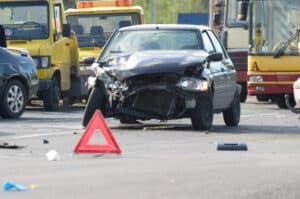
Traffic liability law and traffic accident law deal with questions of liability for damages, in particular accident damage. Traffic contract law, on the other hand, contains all regulations relating to the purchase and sale of a vehicle. In addition, traffic civil law is subject to a special sub-area: travel law.
So the main focus is on accident settlement, compensation for pain and suffering, car purchase and the associated warranty rights as well as car repair. In the event of a traffic accident, an injured party can therefore file claims for damages. These can be made up of the law on damages (Civil Code, § 823 et seq. BGB), the StVG and the Insurance Contract Act (VVG).